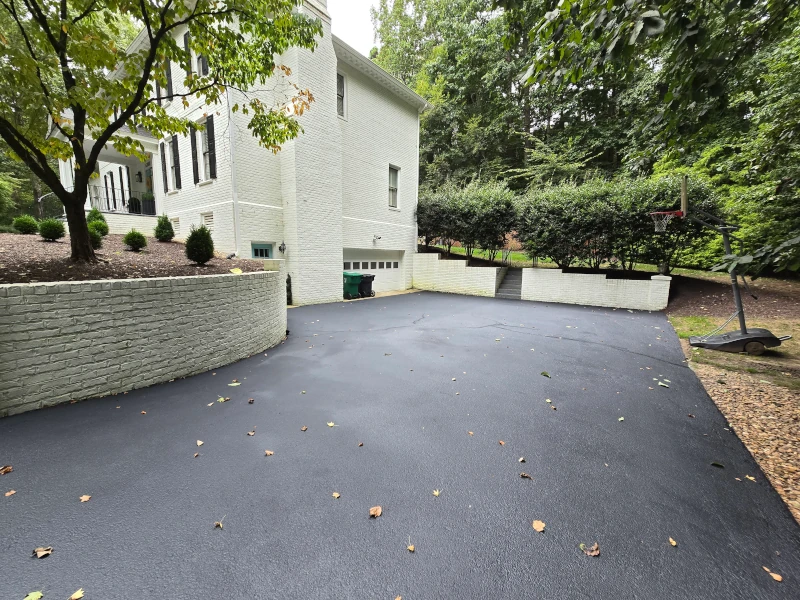
No. You should not seal a brand new asphalt driveway in Richmond. Wait 6 to 12 months after the paving crew leaves, then apply the first sealcoat.
Fresh asphalt still holds light oils that have to evaporate before a sealer can bond to it. Coat it too early and you trap those oils, which leaves a soft surface, a peeling finish, and a driveway that ages faster than one nobody touched.
That single decision, waiting instead of rushing, is worth thousands of dollars over the life of your pavement. A well maintained asphalt driveway lasts 20 to 30 years. One sealed at the wrong time can start failing inside 5. This guide covers the exact timing for Richmond, how our humid summers and freezing winters shift the window, and how to tell your driveway is finally ready. If you already know yours is cured, our driveway sealcoating service in Richmond is the next step.
How Long to Wait Before Sealing a New Asphalt Driveway
Wait a minimum of 90 days, and ideally 6 to 12 months, before the first sealcoat on new asphalt. For Richmond driveways, the practical target is one full warm season of curing.
Curing is not the same as cooling. Your driveway is cool enough to drive on within 24 to 48 hours of paving. Curing is oxidation, the slow chemical hardening of the asphalt binder as volatile oils work their way out of the mat, and that process runs for months.
The Asphalt Institute describes binder oxidation as a gradual reaction that continues well after the pavement is in service. Sealcoating puts a film over the surface. Apply that film before the oils have left and you seal them in.
Use this schedule based on when your driveway was installed:
| Installation Month | Earliest Acceptable Sealcoat | Recommended First Sealcoat | Why |
|---|---|---|---|
| March to May | Late summer, same year | April to June, following year | One full summer of heat drives out oils quickly |
| June to August | Spring, following year | May to July, following year | Peak UV and heat speed curing, but 90 days lands in cold weather |
| September to October | Late spring, following year | June to September, following year | Cool, damp fall slows oxidation significantly |
| November to February | Summer, following year | July to September, following year | Winter paving cures slowest and needs the longest window |
Notice that every recommendation lands between late spring and early fall. Sealer needs surface temperatures above 50 degrees Fahrenheit and rising, plus a dry 24 hour window after application. That rules out most of a Richmond winter.
For a deeper look at scheduling, read our guide on the best time to schedule sealcoating in Richmond.
Why Sealing New Asphalt Too Early Damages the Driveway
Sealing too early traps curing oils under an impermeable film, which keeps the asphalt soft and prevents the sealer from bonding. The result is a coating that peels within one or two seasons and a surface that scuffs, dents, and tracks.
Here is what actually goes wrong, in the order homeowners usually notice it:
- Tracking and footprints. The trapped oils keep the surface tacky. Tires, kickstands, and trailer jacks leave permanent impressions in hot weather.
- Peeling and flaking. Sealer needs a clean, oxidized, slightly porous surface to grip. On a glossy new mat it sits on top instead of bonding, then lifts in sheets.
- Blotchy gray patches. Uneven adhesion shows up as mottled color within 12 months, which is the opposite of the uniform black finish you paid for.
- A softer, weaker mat. Incomplete oxidation leaves the binder more pliable than the mix design intended, so the pavement deforms under point loads instead of resisting them.
- Expensive rework. Fixing a failed early sealcoat is not a matter of recoating. The loose material has to come off first, which means pressure washing, scraping, or in bad cases mechanical stripping.
Any contractor offering to seal your driveway the same week it was paved is either inexperienced or hoping you do not know better. Decline it.
What It Costs to Get the Timing Wrong
| Scenario | Typical Richmond Cost | Outcome |
|---|---|---|
| First sealcoat at the right time | $0.18 to $0.30 per square foot | Sealer bonds, lasts 2 to 3 years, protects the mat |
| Sealcoat applied within 90 days of paving | Same price, plus removal later | Coating peels, surface stays soft, money wasted |
| Stripping and recoating a failed early seal | Roughly 2 to 3 times a standard sealcoat | Labor intensive cleanup before any real protection |
| Skipping sealcoating entirely | $0 up front | Oxidation, raveling, and cracking arrive years early |
| Full driveway replacement | $4 to $8 per square foot | What you are trying to avoid for 20 to 30 years |
Prices are typical Richmond area ranges and vary with driveway size, access, and surface condition. Confirm current pricing before publishing.
How Richmond Weather Changes the Curing Window
Richmond sits in a humid subtropical zone, and that matters more to asphalt curing than most homeowners expect. Wet air slows surface evaporation, heavy rainfall keeps the base saturated, and winter freeze thaw cycles punish anything that has not fully hardened.
Three local factors shape the timeline:
- Rainfall. NOAA climate normals put Richmond near 44 inches of precipitation a year, well above the national average. Water that sits on uncured asphalt slows oxidation and softens the edges.
- Summer humidity. July and August routinely run above 70 percent relative humidity. High moisture in the air slows the evaporation that curing depends on.
- Freeze thaw. Richmond averages roughly 80 nights a year at or below 32 degrees. Water that infiltrates an uncured surface expands on freezing and opens hairline cracks into real ones.
The humidity point deserves its own attention if you are paving in midsummer. We wrote about it in detail in how Richmond humidity affects asphalt.
The local takeaway is simple. A driveway paved in Chesterfield in June cures faster than the identical driveway paved in Henrico in October, because one gets a summer of heat and the other gets a wet, cool winter first.
Five Signs Your New Driveway Is Ready for Its First Sealcoat
Watch the surface, not just the calendar. A cured driveway shows five specific signs, and all five should be present before you schedule the first application.
- The color has shifted from glossy black to matte charcoal. A wet looking, shiny surface means oils are still at the top.
- No oily sheen appears after rain. If puddles show a rainbow film, the binder is still releasing.
- Hot weather leaves no tire marks. Park in the same spot on a 90 degree July afternoon, then check for indentations or scuffing after turning the wheels.
- A kickstand or trailer jack does not sink. Point loads are the fastest way to test firmness. Use a scrap of plywood until you are sure.
- At least one full summer has passed. Heat does the heavy lifting in oxidation. A driveway that has never seen a Richmond July is not ready.
If four of the five check out and the fifth does not, wait another season. There is no penalty for sealing at month 14 instead of month 8. There is a real penalty for sealing at month 3.
How to Care for a New Asphalt Driveway During the First Year
Protect a curing driveway by controlling point loads, keeping chemicals off the surface, and sealing any early cracks. The goal for year one is to reach the first sealcoat with the mat intact.
First 72 Hours
- Keep all vehicles off for at least 24 hours, and 48 to 72 hours in cool or humid conditions.
- No foot traffic in hard soled shoes or high heels on warm days.
- Keep sprinklers and hoses aimed away from the new surface.
First 6 to 12 Months
- Avoid turning the steering wheel while stopped. Power steering twists the surface and leaves scuff arcs.
- Place plywood under jack stands, trailer tongues, motorcycle kickstands, dumpster corners, and ladder feet.
- Keep heavy delivery trucks, moving vans, and construction dumpsters off the driveway entirely.
- Rinse gasoline, motor oil, transmission fluid, and antifreeze immediately. Petroleum products dissolve asphalt binder.
- Support the edges with topsoil or gravel. New asphalt edges have no lateral confinement and crumble if a wheel drops off them.
- Use a plastic shovel, not a metal blade, for snow. Skip rock salt in the first winter.
Fill any crack wider than a pencil line before it takes on water. Early crack treatment is the cheapest repair there is, and our asphalt repair and patching team handles it in a single visit.
What Experienced Contractors Say About Timing
The mistake we see most often is a homeowner sealing a driveway the same season it was paved because it looked finished. It is not finished. Give it a summer. We would rather turn down the job in year one and do it right in year two than come back and strip a coating that never had a chance to bond.
RVA Asphalt Sealcoating, serving Richmond and Central Virginia for more than 20 years
Before publishing, attribute this quote to a named crew lead or owner for stronger E-E-A-T signals.
What a Proper First Sealcoat Looks Like
A correct first application is mostly preparation. The sealer itself goes down in a few hours. What separates a coating that lasts 3 years from one that lasts 1 is everything that happens before the squeegee touches asphalt.
- Clean the surface. Blow off dirt, sand, and loose stone, then wire brush any embedded debris.
- Treat oil stains. Petroleum spots need a primer, or the sealer will not stick to them.
- Seal cracks first. Sealcoat bridges hairline cracks only. Anything wider gets crack filled ahead of time.
- Trim and edge. Grass and mulch at the borders get cut back so the coating reaches the full driveway width.
- Check the forecast. Above 50 degrees, rising, and dry for 24 hours after application.
- Apply and cure. Expect to walk and drive on it within 24 hours in warm weather, or 48 to 72 hours in cooler months.
After that first coat, settle into a 2 to 3 year cycle. You can see finished residential work across the metro on our past work gallery, including driveways in Midlothian, Mechanicsville, and Glen Allen.
New Driveway vs Existing Driveway: What Changes
| Factor | Brand New Asphalt | Driveway 3+ Years Old |
|---|---|---|
| First step | Wait and protect | Inspect and clean |
| Sealcoat timing | 6 to 12 months after paving | Every 2 to 3 years |
| Crack sealing | Rarely needed, monitor only | Almost always needed first |
| Surface color | Deep black, still oily | Gray and faded, aggregate showing |
| Biggest risk | Sealing too early | Waiting too long and letting water in |
| Prep required | Minimal, surface is clean | Washing, priming stains, crack filling |
If your driveway falls in the second column, the decision is usually repair versus reseal. We cover that call in repair or sealcoat your Richmond driveway this spring.
Frequently Asked Questions
Can I seal a new driveway after only 3 months in Richmond?
Technically yes, practically no. Ninety days is the absolute floor cited across the industry, and it only applies when the driveway was paved in peak summer heat and has fully lost its sheen. In Richmond, humidity and rainfall usually push real cure times past that. Waiting until the following warm season is the safer call.
My paving contractor offered to seal the driveway the same week. Should I say yes?
No. Decline it. Sealer applied to an uncured mat traps volatile oils, prevents proper bonding, and typically peels within one or two seasons. A reputable contractor will tell you to wait 6 to 12 months, then schedule the first application.
My new driveway was already sealed too early. What now?
Do not add another coat on top. Have the surface inspected to determine whether the existing coating is bonded or lifting. Loose material has to be removed before any new sealer goes down, which usually means pressure washing or mechanical stripping. In mild cases the coating wears off on its own within a season or two and you restart the cycle then.
When is the best time of year to sealcoat a driveway in Richmond?
Late May through early September. Sealer needs pavement temperatures above 50 degrees Fahrenheit and rising, plus 24 dry hours after application. Richmond summers deliver both consistently. Early fall works when the forecast is stable, but late fall and winter applications risk incomplete curing.
How often should I sealcoat after the first application?
Every 2 to 3 years for a residential driveway. High traffic surfaces, steep grades, and driveways with heavy sun exposure sit at the shorter end. Watch the color rather than the calendar. When the finish turns gray and surface stones start to show, it is time.
Does sealcoating a new driveway make it last longer?
Yes, when applied on a cured surface. Sealcoat blocks UV oxidation, water infiltration, and chemical spills, which are the three forces that degrade asphalt from the top down. Combined with routine crack sealing, it is the main reason a driveway reaches 25 or 30 years instead of 15.
Do you sealcoat driveways outside the city of Richmond?
Yes. We serve the full metro, including Chesterfield, Henrico, Short Pump, Bon Air, Laurel, and Tuckahoe.
Get an Honest Answer on Your Driveway
If you are not sure whether your new driveway is cured, do not guess. We will look at the surface, tell you whether it is ready, and tell you to wait if it is not.
Call 804-825-2991 or request a free estimate from RVA Asphalt Sealcoating. Family owned, fully insured, and sealing asphalt across Richmond and Central Virginia for over 20 years.