Yes, in most cases. A church parking lot in Richmond, Virginia generally has to meet accessibility standards, but not because of the federal Americans with Disabilities Act (ADA). Churches are exempt from Title III of the ADA. The requirement comes from the Virginia Uniform Statewide Building Code (USBC), which applies to religious buildings and does require accessible parking spaces whenever a lot is built, expanded, or restriped as part of a permitted project.
This is the detail that trips up most congregations. The federal exemption is real and well documented, but it does not cancel out Virginia’s building code. If your church provides parking and triggers a building permit, you need ADA-standard accessible spaces.
Understanding why means separating two systems that are easy to confuse. The ADA is federal civil rights law, enforced through complaints and lawsuits after a facility is already open. The USBC is a state construction regulation, enforced by a local building official before the work is approved. A church can sit outside the first system and squarely inside the second, and that is exactly where most Richmond congregations land.
Disclaimer
This article is general information, not legal or engineering advice or a code determination. Codes change, and how a requirement applies depends on your project’s location, occupancy classification, and permit history.
Confirm anything here with your local building official, the Virginia Department of Housing and Community Development, and a licensed architect, engineer, or attorney before acting on it.
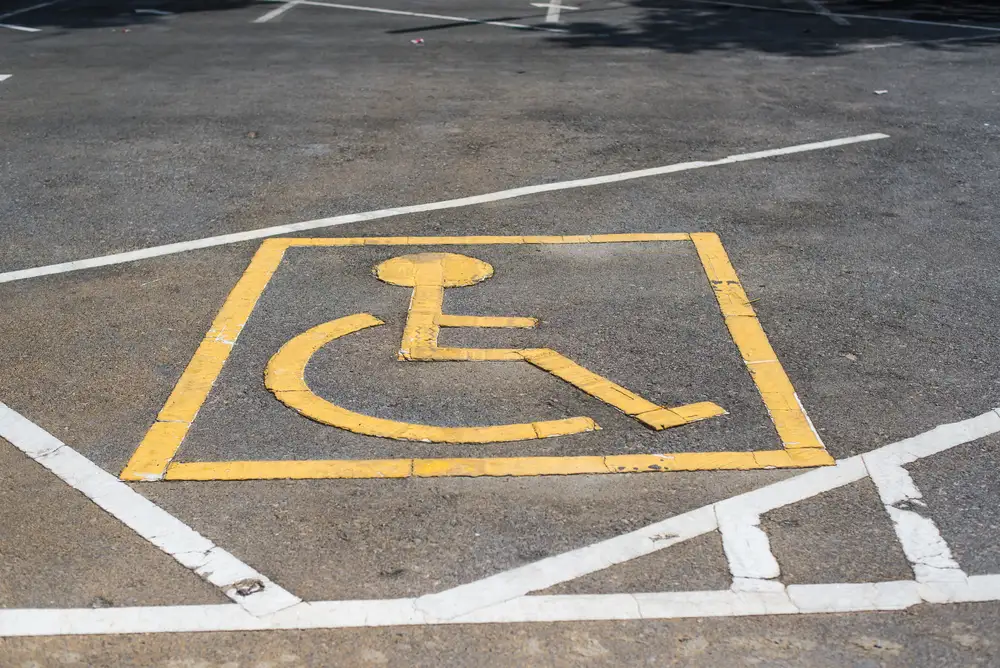
Churches Are Exempt From the Federal ADA
Religious organizations are fully exempt from Title III of the ADA, the section covering public accommodations. This exemption is unusually broad. It covers every facility and program a church controls, including parking lots, and it applies whether the activity is religious or secular, and even when the event is open to the general public.
The exemption is written directly into federal regulation. Under 28 CFR 36.102(e), the Department of Justice states that Title III does not apply to any religious entity. The Department’s own Title III Technical Assistance Manual puts it plainly: religious entities are exempt, and the exemption covers all of their activities. Courts have upheld this on First Amendment grounds, reasoning that federal enforcement against religious bodies would improperly interfere with religious practice.
Where the Exemption Stops
The exemption is broad but not total. Three situations commonly pull a church back into federal accessibility obligations:
- Employment. Title I of the ADA covers employment and has no religious exemption. A church with 15 or more employees cannot discriminate against workers or applicants with disabilities.
- Federal funding. Section 504 of the Rehabilitation Act of 1973 bars disability discrimination by any facility receiving federal financial assistance. There is no religious exemption under Section 504, and its accessibility standards closely mirror the ADA.
- Non-religious tenants. The exemption belongs to the religious organization, not the building. As the DOJ’s Title III Technical Assistance Manual explains, a non-religious entity that leases church space to run a public accommodation is covered by Title III, even though the congregation itself stays exempt. A for-profit daycare or a commercial tenant carries that burden independently.
Why Virginia’s Building Code Still Requires Accessible Parking
The federal exemption does not reach state building codes. Virginia enforces the Virginia Uniform Statewide Building Code, which adopts the 2021 International Building Code with state amendments and supersedes any local building regulation. Chapter 11 of the Virginia Construction Code sets the governing philosophy plainly: everything is required to be accessible unless a specific exception says otherwise.
The only religious-worship carve-out in that chapter is narrow. Section 1103.2.8 exempts raised or lowered areas used primarily for religious ceremonies, such as a chancel, altar platform, or choir loft. That exception says nothing about parking. Section 1106 of the same chapter requires that where parking is provided, accessible spaces be supplied according to the code’s scoping tables, with no religious exception attached.
The difference between the two systems shows up most clearly in how each one is enforced. The ADA is enforced after the fact through litigation, a route that rarely reaches an exempt church. The USBC is enforced before the fact by the local building official, who reviews plans, inspects the work, and signs off before occupancy. A church’s religious status does not change that checklist.
The practical trigger is the building permit. Enforcement of the USBC applies to new construction, additions, alterations, and renovations. A congregation that paves a new lot, expands an existing one, or resurfaces and restripes as part of a permitted project will have its accessible parking reviewed as a condition of approval. Failing that review stalls the permit, which is a far more immediate consequence than a lawsuit that may never arrive.
Because the USBC is enforced locally, the department handling that review depends on where the property sits. A church inside Richmond city limits deals with the city’s building inspections office, while congregations in Henrico or Chesterfield answer to their own county departments. The code itself is identical statewide, but plan review timelines and submittal requirements vary from one jurisdiction to the next.
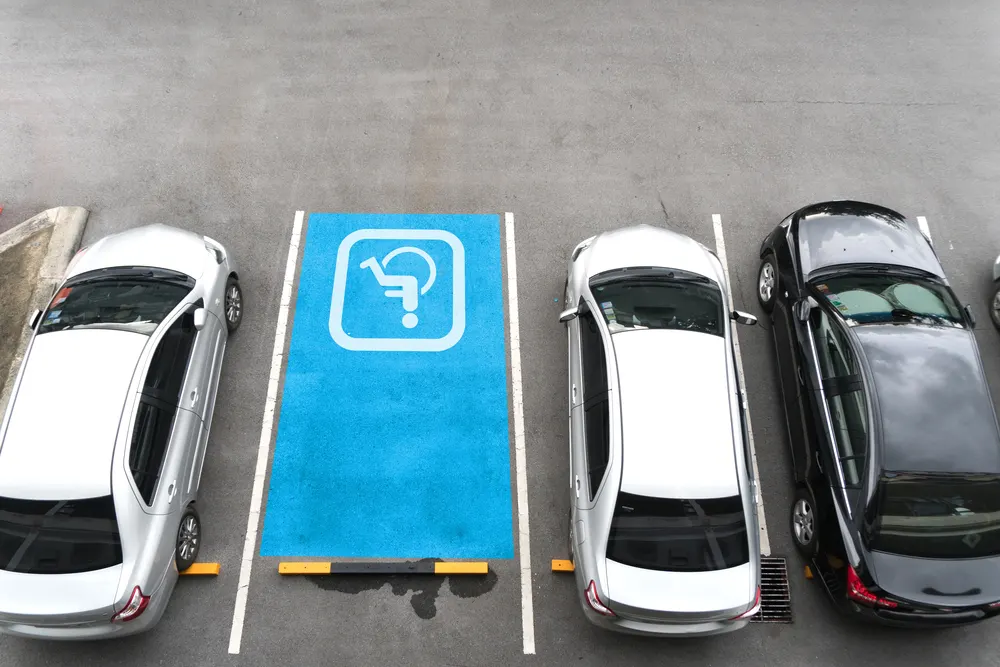
How Many Accessible Parking Spaces Does a Church Need?
The number of accessible spaces is set by the total number of spaces in the lot. Both the 2010 ADA Standards and Virginia’s building code use the same scoping table. At least one of every six accessible spaces, rounded up, must be van-accessible, and any lot with accessible parking needs at least one van space.
| Total Spaces in Lot | Minimum Accessible Spaces | Of Which Van-Accessible |
|---|---|---|
| 1 to 25 | 1 | 1 |
| 26 to 50 | 2 | 1 |
| 51 to 75 | 3 | 1 |
| 76 to 100 | 4 | 1 |
| 101 to 150 | 5 | 1 |
| 151 to 200 | 6 | 1 |
| 201 to 300 | 7 | 2 |
| 301 to 400 | 8 | 2 |
| 401 to 500 | 9 | 2 |
| 501 to 1,000 | 2% of total | 1 per 6 accessible |
Source: 2010 ADA Standards for Accessible Design, Section 208.2; mirrored in Virginia Construction Code Chapter 11, Section 1106.
An Example
A Richmond church with a 90-space lot needs 4 accessible spaces, and at least 1 of those must be van-accessible. A larger campus with 250 spaces needs 7 accessible spaces, 2 of them van-accessible. When a site has more than one separate lot, the count is calculated per lot rather than across the combined total, so a church with two 60-space lots needs 3 accessible spaces in each, not 5 spread across the property.
What Makes a Parking Space ADA Compliant?
An accessible space is more than a painted symbol. The U.S. Access Board’s guidance on parking sets the dimensions and placement rules that Virginia’s code adopts, and each space must satisfy all of them:
- Width. Standard accessible spaces must be at least 8 feet wide. Van-accessible spaces must be at least 11 feet wide, or 8 feet wide with a 96-inch access aisle.
- Access aisle. Each space needs an adjoining marked access aisle at least 5 feet wide so a wheelchair or lift can deploy. Two spaces may share one aisle.
- Vertical clearance. Van-accessible spaces require 98 inches of vertical clearance along the space, the access aisle, and the vehicle route to and from them.
- Surface and slope. Surfaces must be stable, firm, slip-resistant, and nearly level, with slopes no steeper than 1:48 in any direction. That tolerance is tight enough that standing water pooling in an access aisle usually signals the slope is already out of compliance.
- Location. Spaces must sit on the shortest accessible route to an accessible entrance. Where there are multiple entrances with parking, accessible spaces are dispersed among them.
- Signage. Each space needs an upright sign with the International Symbol of Accessibility, and van spaces must add a “van accessible” designation. Signs must be high enough not to be hidden by a parked vehicle. Where a site has four or fewer total spaces, identification signage is not required.
What Safe Harbor Means for an Existing Lot
Older parking lots get some breathing room. Under the ADA’s safe harbor provision, parking that already complied with the 1991 Standards generally does not have to be upgraded simply because the 2010 Standards raised the bar. That protection lasts only until the lot undergoes a planned alteration.
The line between maintenance and alteration matters here. Filling potholes or sealcoating is upkeep and does not trigger the obligation. Resurfacing and restriping do. According to the Department of Justice’s guidance on restriping parking spaces, once that work happens the new layout must meet the 2010 Standards to the maximum extent feasible. For most churches this is good news on timing, because the restriping project becomes the natural moment to bring the lot current rather than a separate capital expense.
Richmond’s freeze-thaw cycles make that timing fairly predictable. A lot showing winter damage in March is already a candidate for resurfacing, and folding the accessibility upgrade into that same project spreads the cost across one mobilization instead of two. Working from a seasonal maintenance checklist makes it easier to catch the trigger before a contractor is already on site.
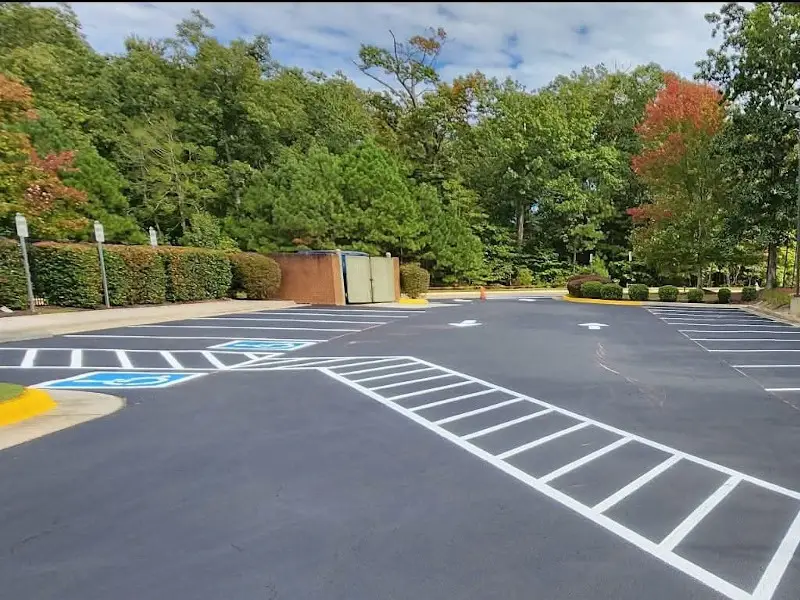
Why Richmond Churches Should Prioritize Accessible Parking
Beyond code, accessible parking is a practical ministry decision. According to the Centers for Disease Control and Prevention, more than 1 in 4 U.S. adults, or 28.7 percent, lives with some type of disability, and mobility is the most common category. The figure climbs sharply with age, which matters for congregations whose most faithful attenders are often their oldest.
“Church accessibility starts on the outside of your building,” notes the facilities guide published by ChurchPlaza, which points out that the lot is the first barrier a visitor meets. A member who cannot safely cross a cracked, unmarked lot in the rain will eventually stop trying, and no one on staff will ever hear the reason. A welcoming lot signals a welcoming congregation before anyone reaches the door.
- Wider reach. Accessible parking lets older members, families with strollers, and visitors recovering from surgery or injury participate fully.
- Reduced liability. Compliant, well-maintained lots lower the risk of trip-and-fall claims and avoid permit delays on future projects.
- Long-term property value. Facilities built to current code are easier to sell, lease, insure, or convert to another use later.
If you are unsure whether your lot already meets the count and dimension requirements, a measured walkthrough is usually enough to tell. Contractors who work on church parking lots in the Richmond area can flag the gaps before a permit application puts them on the record.
Frequently Asked Questions
How many accessible spaces does a 60-space church lot need?
Three, and at least one has to be van-accessible. Lots of 51 to 75 spaces fall in the same bracket, so the answer holds anywhere in that range. The van requirement catches people off guard because it applies at every size: even a 20-space lot needs its single accessible space to be van-accessible, since the rule is one van space per six accessible spaces or any fraction of six.
Can you add signs instead of restriping the spaces?
No. Signage is one of six requirements, and it is the only one that cannot stand alone. An accessible space also needs the right width, an adjoining access aisle at least 5 feet wide, a firm and nearly level surface, and placement on the shortest route to an accessible entrance. A sign posted over an 8-foot space with no access aisle does not create an accessible space, because the aisle is what allows a wheelchair or lift to deploy.
Do you need a building permit just to restripe the lot?
Often no, but confirm before scheduling the work. Virginia’s building code at Section 102.3 excludes parking lots and sidewalks that are not part of an accessible route from the code’s scope. Accessible spaces, their access aisles, and the route connecting them to the entrance are part of an accessible route, so that portion stays within scope regardless. Permit practice also varies between Richmond, Henrico, and Chesterfield, so one call to the building official before the contractor mobilizes is worth more than an assumption.
Does anyone inspect church parking lots if you are not pulling a permit?
No one is coming to check. Virginia’s building code is enforced through permit review and inspection, which means nothing happens until an application is filed. That is why non-compliant parking tends to surface at the worst possible time: mid-project, when a plan reviewer flags it and the fix has to be engineered into work that was already budgeted and scheduled.
Do you need accessible spaces if the lot is gravel?
Yes, and gravel creates a specific problem. The space count is based on how many spaces you provide, not what they are surfaced with. But accessible spaces and access aisles have to be firm, stable, and slip-resistant, and loose gravel shifts under wheels, canes, and walkers. Federal accessibility evaluations routinely cite gravel lots for exactly this. The usual fix is a paved pad covering the accessible spaces, the access aisle, and the route to the entrance rather than paving the whole lot.